
When a home or business has been damaged, customers need a fast response, clear information and confidence that the repair is under control. Delivering that service across Australia takes experienced people, reliable systems and sound decisions behind the scenes, particularly when major weather events require teams to travel into affected regions at short notice.
In 2025, Midcity completed 12,434 insurance repair jobs. The scale and nature of that work shape how the business approaches environmental, social and governance performance, from supporting colleagues and managing suppliers to understanding and reducing its environmental impact.
Midcity Executive General Manager Rosie Pratarelli said: “When somebody has damage to their property, they want clear answers and confidence that the work is under control. Our investment in people, reporting and governance helps our teams give customers that confidence, whether it’s a single repair or responding to widespread damage after a major weather event.”
A clearer view of environmental performance
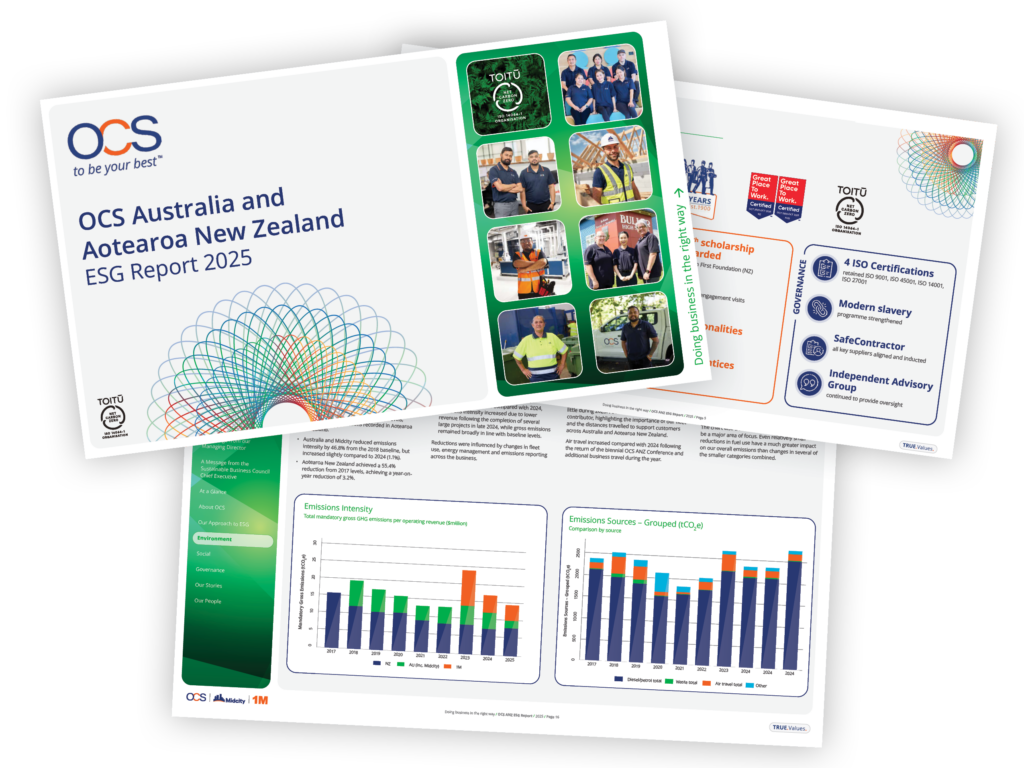
Midcity’s progress is included in the 2025 OCS Australia and New Zealand ESG Report. As environmental results for OCS Australia and Midcity are reported together, the published figures reflect both businesses: in 2025, their combined gross emissions were 5.9% below the 2018 baseline while emissions measured against operating revenue (emissions intensity) were 46.8% lower.
Midcity is included within OCS Australia’s Toitū Net Carbon Zero certification. The independently verified programme provides a consistent framework for measuring emissions, checking the data and identifying where reductions can be made across the business.
Fleet remains the largest source of emissions, with suitable electric, hybrid and plug-in hybrid vehicles accounting for 7.7% of the combined Australian fleet. Fuel use has increased as the business has grown and responded to catastrophes, particularly where teams must travel across regional and remote areas. For some of this work, suitable lower-emission vehicles and charging infrastructure aren’t yet widely available.
“Seven point seven per cent is well short of where we want to be,” Rosie said. “Many of our teams need vehicles with substantial towing capacity, and charging infrastructure isn’t yet reliable across the distances they cover. We can’t compromise our response capability, so we’ll keep assessing lower-emission options against the work our teams actually do.”
Supporting the people who deliver the work
Midcity achieved Great Place to Work® certification in 2025, based on independent feedback from colleagues. An experienced and supported workforce helps Midcity maintain capacity, consistent workmanship and communicate clearly with customers throughout a repair.
“A customer’s experience of Midcity is shaped by everyone they work with, from the account managers and repair coordinators they speak with on the phone to the person who arrives at the property,” Rosie said. “When colleagues feel supported and have the right systems behind them,
they’re better placed to explain what happens next, keep the customer informed and deliver the repair well.”
That support also extends into the communities where Midcity operates. In Western Australia, the business began supporting Jetz Netball Club, helping more than 100 junior and senior players take part, while colleagues volunteered with Wheelchairs for Kids in Wangara to assemble and check all-terrain wheelchairs for children overseas.
Stronger checks behind delivery
Insurance repair work relies on a wide network of suppliers and contractors, making clear standards and effective oversight an important part of service delivery. During 2025, OCS Australia & New Zealand updated its Sustainability Code of Conduct for suppliers and contractors and embedded it into onboarding. The wider business also continued working with Fair Supply to assess modern slavery risk, supported by a cross-functional working group responsible for due diligence, supplier engagement and response activity.
For Midcity, these controls help set clear expectations for the businesses working on its behalf and give customers greater confidence in how supply chain risks are managed. Alongside the progress recorded in the report, they also show where further work is needed across the people, environmental decisions and governance systems behind each repair and project.